

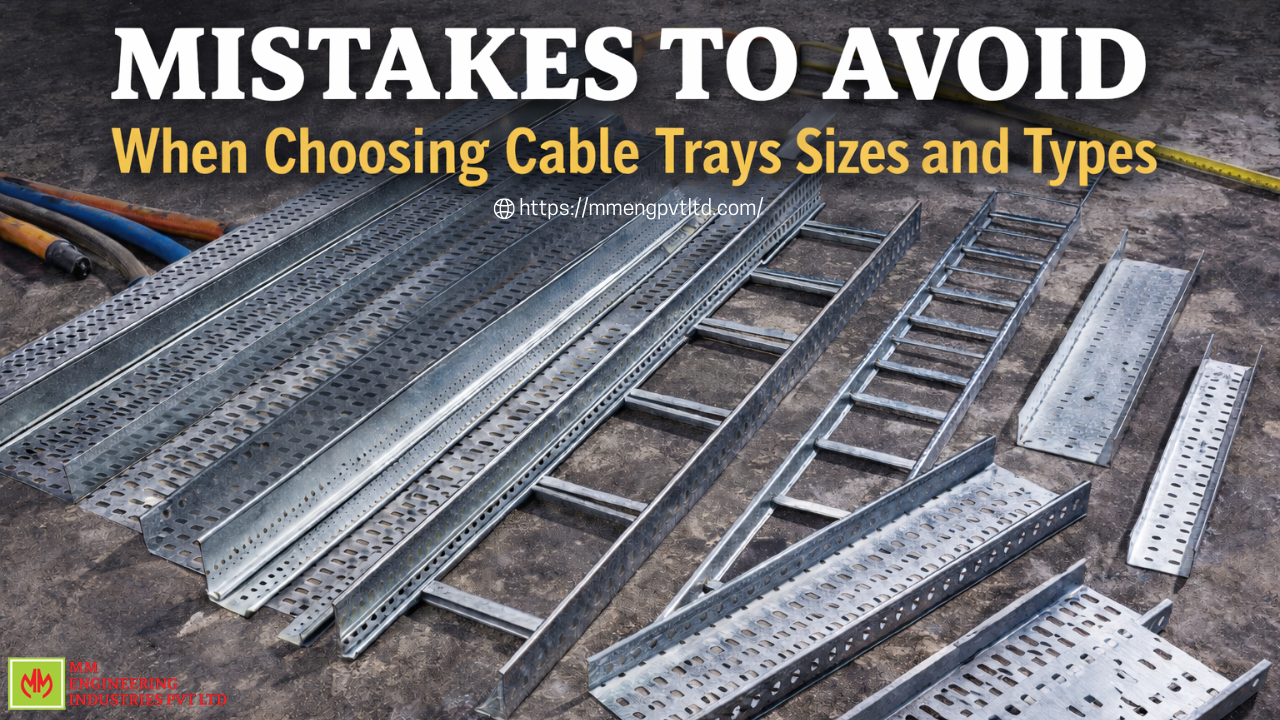
In the development of the electrical installation in the booming industrial and commercial sectors of Vadodara, the choice of an appropriate cable management system plays a vital role in the safety, efficiency, and the durability of the performance. Cable trays are used to provide the foundation of systematized wiring, where power and data cables are supported in and between buildings, factories, and external utilizations. Nevertheless, a good number of contractors, facility managers and electricians err very badly in selecting cable tray sizes and types that result in expensive repairs, hazards to the safety and eventual failure of the system in the future.
The pitfalls of cable tray selection will help to save time, money, and possible compliance problems. Whether you are engaging in a new construction project in GIDC Makarpura or refurbishing an old facility in the Gorwa industrial sector, this definitive guide will enable you to go through the selection process with a lot of confidence.
Understanding Cable Tray Systems: The Foundation of Smart Selection
It is imperative to know why cable management systems are so crucial before getting down to the pitfalls. These are organised channels which give mechanical support to insulated electrical cables in power distribution, control circuits, and telecommunication systems. They provide flexibility, access, and protection which conduit systems simply cannot provide over large scale installations.
The diversity that the market is offering today such as the types of ladders; the ladder-type ladder to the perforated ladder, aluminum to galvanized steel means there is a perfect solution to any task. The problem is the inability to find a way to align your needs with the proper product characteristics.
Mistake 1: Neglecting Load Capacity Requirements
The worst mistake that can ever be made is to underestimate the amount of cable load that you will require your tray system to sustain. Most installers only determine the quantity of cables but do not compute the weight.
Why this matters:
- Cables can be very lightweight or heavyweight depending on the size of the conductor, the kind of insulation used and also the shielding.
- Expansion plans in the future are usually an unwanted burden.
- The system can be stressed by dynamic loads that are caused by maintenance activities.
- Excessive trays may get out of shape leading to damage of cables and posing a safety risk.
The solution: Divide the total weight of all cables by a minimum of 25 of the weight to be added and then divide the result by 4. Call manufacturer load tables which define maximum spans between supports with various tray widths and tray depths. This calculation is even more severe in the industrial areas of Vadodara where heavy-duty power cables are typical.
Mistake 2: Selecting the Wrong Material for Your Environment
The environmental factors really have a significant influence on the life and performance of the cable management infrastructure. The selection of materials without accounting the factors of exposure is a disaster of untimely breakdown.
Common material selection errors:
Galvanized Steel in High-Corrosion Areas Although it is economical, normal galvanized steel decays rapidly in chemical plants, areas bordered by the sea or in places with high moisture. The closeness to the gulf of Khambhat is such that there are areas in Vadodara with more moisture than others.
Aluminum Where Fire Resistance is Critical Aluminum can provide a great deal of corrosion resistance and it is quite lightweight, but does not have as high fire ratings as steel. Processing plants and mills like food processing and textile, pharmacy businesses need enhanced fire-resistance standards.
PVC in High-Temperature Environments Fiber-reinforced plastic trays degrade when exposed to continuous high temperatures common in foundries, boiler rooms, or outdoor installations under direct sunlight.
The better approach: Choose material properties to suit environmental conditions; stainless steel in corrosive conditions, hot-dipped galvanized steel in conventional industrial usage and finally powder-coating to offer aesthetic commercial uses.
Mistake 3: Incorrect Size Selection Based on Fill Ratio
Knowledge of cable tray sizes and types also includes the knowledge of correct fill ratios. One of the issues that many installers cause is overloading trays with cables that are too many.
There are industry standards on maximum fill ratios:
- Power cables: 40-50% fill capacity
- Control cables: 50% fill capacity
- Communication cables: 50% fill capacity (though some standards allow higher for specific applications)
Why proper sizing matters:
- The spacing is sufficient to avoid excess heat that may ruin the insulation.
- Fewer man hours are spent on installation of the cables.
- The additions and changes in the future are made easy.
- Increased airflow increases the cable life.
- Maintenance access and troubleshooting is enhanced significantly.
Calculation example: 20 power cables on a 50mm diameter tray, the area of the cable should be approximately 39270 square millimeters. The tray (20 percent fill ratio) must be at least 98175 square millimeters in size, that is, the size of a 300mm by 100mm tray.
Mistake 4: Ignoring the Location of Installation and Mounting
The physical environment of installation determines the kind of tray that would work best. Using trays in the form of ladders when placing them in a tight space or using trays with a solid bottom when placing them outside the building is a basic misconception.
Location-specific considerations:
Indoor Installations
- Aesthetically-pleasing designs are required in ceiling-mounted systems of commercial buildings.
- Hidden spaces have the ability to employ less costly alternatives.
- Vertical runs require different support than horizontal spans
Outdoor Applications
- Exposure directly to the sun requires UV resistant materials or protective fabrics.
- Water and precipitation demand perforated or ventilated designs which are friendly to drainages.
- Rooftop installations require the calculation of wind loading
Underground or Enclosed Spaces
- The concept of ventilation is imperative to avoid heat build up.
- To control the moisture, special attention should be paid to the choice of materials.
- Maintenance access has to be intended.
With the enclosed environment of pharmaceutical manufacturing and the open environment of chemical processing units, the ability to understand such differences leads to retrofits that are expensive to implement in Vadodara which is in a varied industrial environment.
Mistake 5: Neglecting Expansion and Future Modifications
Electrical systems evolve. Equipment is added, processes are modified, and technology upgrades are adding cabling. Day one will increase cable tray capacity to the maximum, which will not allow adding capacity to it.
Plan for the future by:
- Putting systems in 60-70 percent predetermined initial capacity with expansion opportunities.
- Setting up bigger trays even in the areas that are not required immediately.
- The development of rational routing that should support extra branches.
- Writing the system in detail to be referred to in future.
- Taking into consideration modular designs, which ease the maintenance of change.
The difference in costs between a 300mm wide tray and the 450mm wide tray is very small as compared to the cost of the entire system redesign in case of expansion of the system.
Mistake 6: Ignoring Local Codes and Standards
The electrical installations should be in conformity to the IS standards, the National Electrical Code requirements and the local regulations in Gujarat and in Vadodara city.
Critical compliance areas include:
- Minimum building system clearances.
- Wall and floor penetration requirements in fire-stop.
- Spacing of support and load computation.
- Industrial facilities Hazardous location classifications.
- Hazardous location classifications in industrial facilities.
Failure to comply may lead to inspections failing, insurance problems and severe safety violations. Experienced suppliers with whom one works, who are aware of the local needs, can navigate through this thorny terrain.
Mistake 7: Choosing Price Over Quality and Total Cost of Ownership
The temptation to use the cheapest choice usually comes to haunt in cable management systems. A low cost tray that breaks down early, needs extra repairs or damages cables is much more expensive than quality items.
Consider total cost of ownership:
- The first cost is only 20-30% of the lifetime costs.
- Difficult to work with products incur high costs of installation labor.
- Service and replacement cycles have an effect on continuous operations.
- Failure of the system may result in thousands of hours of production costs.
- Mature manufacturers have superior warranties and support on quality products.
Mistake 8: Inadequate Support and Fastening Systems
Even cable trays, which were perfectly specified, fail to work when they are not supported properly. Support spacing, choice of fasteners and mount techniques have a direct effect on system integrity.
Support system requirements:
- Follow manufacturer specifications for maximum span between supports
- Use appropriate anchors for the mounting surface (concrete, steel, wood)
- Install seismic bracing in areas prone to earthquakes
- Ensure connections between tray sections are mechanically and electrically sound
- Check support structures are able to support dynamic loads when in maintenance.
Making the Right Choice for Your Project
Avoiding these common mistakes requires a systematic approach to cable management system selection:
Step 1: Site Survey Carry out the site survey Document environmental conditions, cable types and quantities, future extension plans, and accessibility requirements.
Step 2: Compute real needs Establish the overall cable weight, tray space required depending on the fill ratios, and the support spacing requirements.
Step 3: Specify to conditions Choose materials, types and sizes that would be appropriate to your needs in the context of your environment and operations.
Step 4: Check code compliance Check that your design is within all the standards and local regulations.
Step 5: Future plan Prepare to grow Build in capacity and write up your system.
Step 6: Choose quality suppliers Partner with experienced manufacturers who offer technical support, quality certifications, and proven track records.
Conclusion
The choice of the cable trays sizes and types must be made with references to the current needs and requirements along with future needs, condition of the environment, safety requirements, and budget measures. The errors discussed in this guide are the most frequent and expensive errors in the specification and installation process of the industrial and commercial sector of Vadodara.
With this thorough, knowledgeable strategy to select, looking at load capacity, environmental factors, proper sizing, installation, and expansion needs, code compliance, quality, and support provisions, you can have a cable management infrastructure which will serve your facility many decades.
In all projects that entail the use of long-lasting code compliant cable management solutions within the boundaries of Vadodara, MM engineering industries Pvt Ltd would have the capability to provide expert advice and products of high standards that can be used to meet the rigorous demands of the contemporary electrical installations. Unnecessary flaws should not ruin the success of your project therefore, take time to plan and specify effectively and make sure that your cable management system works perfectly as the first day.
Next time you are ready to make the correct choice in your project? Always analyze your needs, adopt the services of the professionals working in your field, and choose the products that will provide real long-lasting value but not a low cost at the moment.